
Functional cardiology at Advanced Functional Cardiovascular Care begins with a question that most cardiovascular encounters rarely pause to ask: what is actually driving this, at the biological level, and what does this body need to move toward durable cardiovascular health?
The answer requires a physician who reads the cardiovascular system as one interconnected biological story, shaped by the metabolic environment, the inflammatory burden, the autonomic nervous system, the hormonal landscape, and the structural and electrical integrity of the heart itself. At AFCC, that reading is the foundation of every evaluation, every plan of care, and every decision made on behalf of every patient. Functional cardiology at this depth is cardiovascular medicine practiced at the full level that the complexity of heart disease has always required.
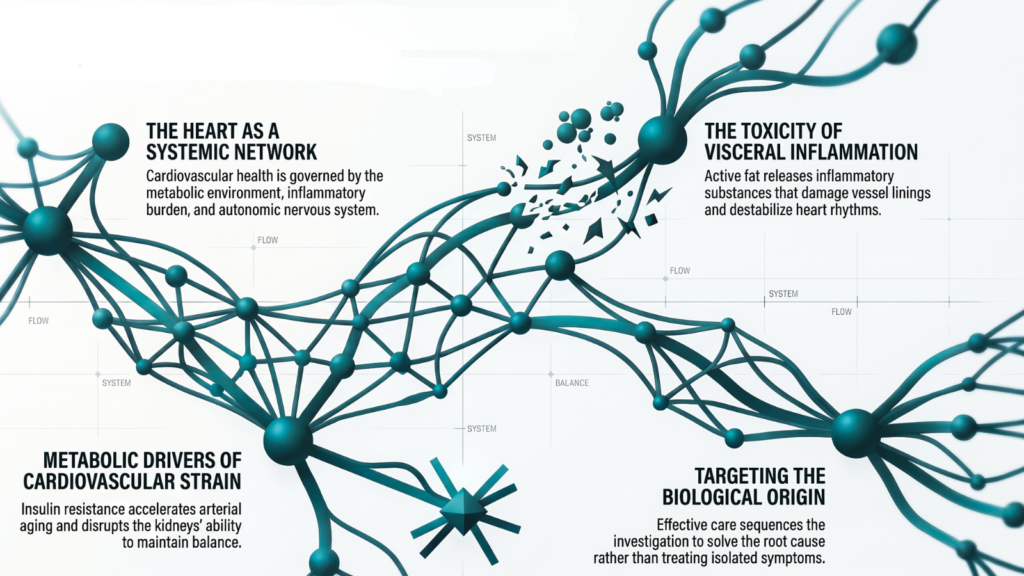
The Body as One System
The cardiovascular system is deeply and inseparably connected to every other system in the body that governs it. The heart responds to signals from the autonomic nervous system, to the metabolic inputs of insulin and glucose regulation, to the inflammatory substances released by visceral fat, and to the hormonal environment shaped by stress and endocrine function. It responds equally to the quality of sleep and recovery that determines how completely the body restores itself each night. When any of these systems is under sustained strain, the cardiovascular system absorbs that strain and eventually expresses it.
Visceral fat, the metabolically active fat concentrated deep within the abdominal cavity, releases inflammatory substances directly into the bloodstream that damage the inner lining of blood vessels, promote the development of soft unstable plaque within the arteries, and alter the electrical environment of the heart in ways that create the substrate for rhythm disturbance. Insulin resistance compounds this process at every level, driving the inflammatory burden higher, impairing the kidney’s ability to clear uric acid, disrupting the hormonal balance that governs cardiovascular resilience, and accelerating the atherogenic process within the vessel wall. The autonomic nervous system, operating within these competing physiologic demands, loses its ability to regulate blood pressure and heart rate with precision, producing the instability, the fatigue, and the symptoms that bring patients to evaluation. This framework is explored further in our physician-authored position paper on cardiometabolic health and the limits of standard monitoring.
These are interconnected biological forces operating simultaneously within one body. Functional cardiology at AFCC investigates and treats them as exactly that.
Who Functional Cardiology Serves
Functional cardiology at AFCC offers every person whose cardiovascular health deserves a complete answer a physician who asks why, pursues that question to its biological origin, and builds a plan of care around what the answer reveals.
For the person reading this page, that means arriving at a practice where the full complexity of their cardiovascular health is taken seriously from the first encounter. It means receiving an evaluation that reads every system as part of one interconnected story, with every finding interpreted in the context of every other finding, and every next step decided by the physician who holds the complete biological picture. It means understanding, perhaps for the first time, what is actually driving the symptoms, the numbers, and the trajectory that prior evaluations have described but not yet fully explained.
It means having a physician who defines success before the investigation begins, who sequences the work with clinical precision, and who remains the singular point of continuity across the entire care relationship. At AFCC, functional cardiology is the standard of care. The investigation reveals the origin. The protocol addresses it there.
Functional Cardiology in Practice
To illustrate how functional cardiology is applied at AFCC, picture the following hypothetical presentation.
An individual presents with a recent transient ischemic attack (mini-stroke), nocturnal palpitations arriving in the early morning hours with a rapid and irregular quality, pre-diabetes, central obesity, a history of gout and hormonal imbalance.
These can be viewed as six different findings, each treated as a separate issue. At AFCC, the common thread is investigated to evaluate the main drivers of the cardiovascular abnormalities, in this case, the irregular heart rhythm and the transient ischemic attack.
Insulin resistance is the main organizing force. The pre-diabetic hemoglobin A1c is a late marker of a process that has been operating at the cellular level for years. The central adiposity is not a weight concern but rather an active endocrine organ releasing pro-inflammatory cytokines into the portal circulation, damaging the endothelial lining of blood vessels, promoting the formation of soft unstable plaque within the cerebral and coronary vasculature, and creating the systemic inflammatory environment that advanced silently until it produced its first visible cardiovascular consequence, the transient ischemic attack.
The nocturnal palpitations reflect a directly connected dimension of the same story. The inflammatory mediators released by visceral adipose tissue reach the atrial myocardium and alter its electrical environment, promoting the substrate for paroxysmal atrial fibrillation. The early morning timing aligns with the circadian nadir of vagal tone, the window in which autonomic imbalance is most likely to permit atrial electrical instability to express itself.
The hormonal imbalance is a mechanistically connected consequence of the same metabolic environment, driven by the visceral fat. The result is a self perpetuating cycle in which hormonal suppression drives further fat accumulation, which drives further insulin resistance, which drives further hormonal suppression.
The gout is the kidney communicating that the metabolic burden has exceeded its capacity to maintain normal uric acid clearance. Insulin resistance impairs renal uric acid excretion. Elevated insulin levels reduce uric acid clearance independent of diet. The joint inflammation is not a separate rheumatologic event but rather the same main biological driver speaking through yet another body system.
Six findings. One origin. The investigation and plan of care that follows is built with the precision that this biological story demands.
The AFCC Standard
At Advanced Functional Cardiovascular Care, every finding from every system is interpreted simultaneously, integrated into a single biological picture, and translated into a personalized plan of care that addresses what that picture has revealed. The investigation is precise because the thinking that precedes it is precise. The plan of care is comprehensive because the story it is built upon is complete.
Care at AFCC is structured and delivered across a sustained physician partnership. Visits are designed for depth and careful review. Results are interpreted in the context of the complete clinical picture. Each next step is decided by the physician who has held that picture from the first encounter. Progress is measured through trends and change over time, and the plan of care is refined as the patient’s physiology responds and evolves.
Advanced Functional Cardiovascular Care is the only concierge practice in Atlanta dedicated exclusively to preventive and functional cardiovascular medicine. For patients who have sensed that a more complete answer exists, and for physicians whose patients deserve a cardiovascular investigation equal to the complexity of their presentation, this is where that standard is met.
Explore our Clinical Pathways to learn more about the structured heart health areas we focus on at AFCC.